Compassion Focused Therapy (CFT)

Compassion-focused therapy (CFT) is a form of psychotherapy developed by Paul Gilbert for people struggling with shame and self-criticism. It is an integration of ideas concerning: Jungian archetypes; evolutionary approaches to human behavior, suffering, and growth; neuroscientific and cognitive-behavioral ideas about the way that people think and behave; and Buddhist philosophy concerning compassion and mindfulness (Gilbert, 2009, 2010, 2014). There is considerable evidence that developing self-compassion is associated with a wide range of benefits including the ability to build positive relationships, increased physical and mental well-being, or the ability to manage voices in psychosis.

+ Show all problems

What Is Compassion Focused Therapy?

Assumptions of CFT

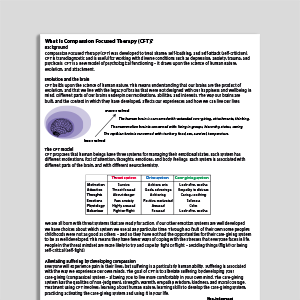
  • human brains/​minds have evolved and have evolved needs (e.g., affection, care, protection, belonging), competencies (e.g., mentalizing, empathy, ability for fantasy) and drives (e.g., seeking safety, achieving dominance). These needs/​competencies/​drives are associated with different brain systems (old brain / new brain);

  • human beings have ‘social mentalities’ that enable them to seek out and form certain types of relationships. In these mentalities or ‘mind sets’ we are motivated to engage in different types of behavior, e.g., care-giving, care-seeking, safety-seeking, achievement-seeking;

  • the ability to self-soothe is linked to our attachment experiences;

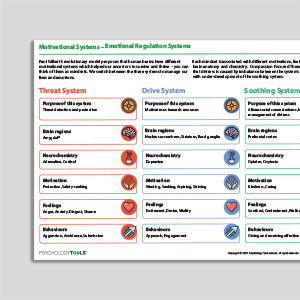
  • humans have at least three types of emotional regulation systems: threat-focused and protection and safety-seeking; drive, excitement, and vitality; affiliative-focused soothing system;

  • distress and dysfunction may arise from problematic inputs into the emotion regulation systems (e.g., being made homeless, being trapped in an abusive relationship) or because of dysregulation of the systems (e.g., poorly developed self-soothing abilities);

  • the soothing system is our brain’s natural ‘threat regulator,’ which can be activated by disengaging from internal stimulators of threat (e.g., rumination, self-criticism) or by distancing oneself from one’s inner emotions (e.g., via mindfulness). Once activated this system can be used to approach aversive inner experiences in a compassionate frame of mind.

Procedures and Techniques in CFT

  • psychoeducation to understand our evolved minds/​brains (old brain / new brain);

  • the use of mindfulness techniques to compassionately ‘stand back’ from turbulent cognitions and emotion;

  • the practice of self-soothing techniques to physiologically change one’s state in order to access different social mentalities;

  • to develop self-compassion using imagery in order to activate the brain’s natural threat regulator;

  • the use of the (above described) ‘compassionate foundation’ as a base from which to explore and engage with aversive or traumatic inner experiences.

References

  • Gilbert, P. (2009). Introducing compassion-focused therapy. Advances in Psychiatric Treatment, 15(3), 199–208.

  • Gilbert, P. (2010). Compassion focused therapy. CBT Distinctive Features Series. New York: Routledge.

  • Gilbert, P. (2014). The origins and nature of compassion focused therapy. British Journal of Clinical Psychology, 53(1), 6–41.

Links to external resources

Psychology Tools makes every effort to check external links and review their content. However, we are not responsible for the quality or content of external links and cannot guarantee that these links will work all of the time.

Please login to view our external resources.